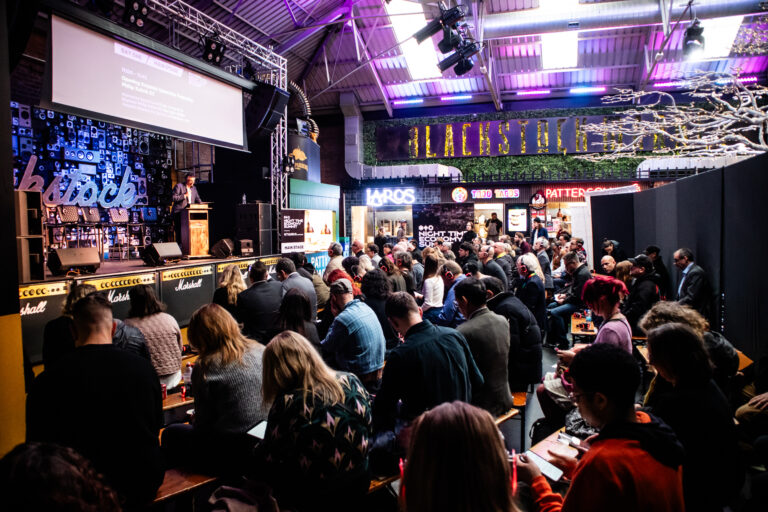
The International Nightlife Association (INA) has continued its active participation on Day Two of the Night Time Economy Summit 2026 (NTES26), held at Blackstock Market in Liverpool, United Kingdom, reinforcing its role in strengthening international governance within the nighttime economy.
Following a first day focused on positioning nightlife as essential urban infrastructure, the second day of the Summit shifted toward institutional consolidation, cross-border coordination, and the development of structured frameworks to support long-term sector stability.
Connecting Nightlife Across Borders: Global Collective Momentum
Michael Kill, Vice President of the INA and CEO of the Night Time Industries Association (NTIA UK), moderated the panel entitled: “Connecting Nightlife Across Borders: International Nightlife Association Board Announcement Marks Global Collective Momentum”.
The session brought together key international figures including:
- Danny Loong, President of the Singapore Nightlife Business Association (SNBA)
- Helking Aguilar, President of Mexican Nightlife Association (AMBADIC)
- Freek Wallagh, Night Mayor of Amsterdam
- Joaquim Boadas de Quintana, President of the International Nightlife Association (INA)
- Martina Brunner, Executive Director of Vienna Night Office
- Raheem Manning, Night Mayor of Philadelphia
- Jim Peters, President, Responsible Hospitality Institute (RHI)
The discussion focused on strengthening international cooperation between nightlife associations, city networks, and policymakers, highlighting the increasing need for structured global alignment in governance approaches.
INA Advisory Board Announcement: Strengthening Strategic Coordination
During the panel, the creation of the INA Advisory Board was formally announced as a strategic initiative designed to enhance institutional coordination, foster regulatory clarity, and reinforce long-term international collaboration within the sector.
The INA emphasized that this step follows the General Meeting held last year, during which the Association approved significant bylaw amendments. Two months ago, these updated bylaws were formally implemented, expanding INA’s territorial structure to encompass 30 members of the Advisory Board, strengthening its global representation.The Advisory Board has been created as a direct response to this expansion, ensuring that as the organization grows, governance remains strategically aligned and internationally coordinated.
As highlighted during the session, the INA is driven by a clear objective: to ensure that the global nightlife sector comes together collectively, breaking down borders and strengthening communication between territories. The industry’s challenges are often remarkably similar across countries, even if the regulatory environments differ.
By creating structured channels for dialogue, the INA aims to share best practices more effectively and develop adaptable solutions for diverse governance frameworks. Michael Kill emphasized that “the industry comes first, second and third”, underlining the need to prioritize sector stability, representation, and advocacy at every level.
A Platform for Expertise and Cross-Border Dialogue
The INA Advisory Board will integrate senior experts and institutional leaders capable of contributing strategic insight to move the sector forward. Its purpose is not only symbolic but operational:
- To facilitate direct communication between territories
- To encourage proactive engagement: “pick up the phone and ask what is happening in each place.”
- To provide expert guidance whenever members face regulatory or structural challenges
- To support advocacy efforts aimed at pushing boundaries responsibly and effectively
The INA recognizes that without sufficient voices and coordinated representation, advancing policy discussions becomes significantly more difficult. Advocacy requires unity, expertise, and strategic positioning.
The Advisory Board may include up to 30 members, reflecting the expanded territorial structure. Currently, four members have formally joined and been announced in today’s summit:
- Freek Wallagh, Night Mayor of Amsterdam
- Michael Rodrigues, 24-Hour Commissioner New South Wales
- Sacha Lord, President of NTIA UK
- Raheem Manning, Night Mayor of Philadelphia
Additional conversations are ongoing with other international leaders who are expected to join in the coming months.
Expanding the Governance and Policy Conversation
Day Two featured more than 40 sessions across multiple stages, consolidating NTES26 as one of the most structurally comprehensive gatherings of the global nighttime economy. Beyond the INA-led panel, the program addressed a wide spectrum of governance, regulatory, cultural, and economic challenges shaping the future of nightlife.
A significant portion of the discussions focused on urban policy integration, with sessions examining the evolving role of Night Mayors, city-led commissions, and cross-department coordination models. Panels such as “After Dark, Ahead of the Curve” and “From Curfews to Culture” explored how municipalities are moving from restrictive approaches toward strategic integration of nightlife within broader urban development agendas.
Regulatory modernization was another central theme. Sessions including “Martyn’s Law and the Future of Counter-Terrorism in Venues and Public Spaces” and “Securing the Future: Navigating Contractor Schemes, Compliance and Rates” addressed compliance complexity, security obligations, and the operational pressures venues face within increasingly demanding regulatory frameworks. The dialogue reflected a growing need for proportionality, clarity, and coordinated enforcement approaches.
Economic sustainability and operational resilience were also extensively discussed. Panels such as “Winning the Energy Game” and “Mastering the Art of Selling Tickets” highlighted the financial pressures facing operators, from energy costs to ticketing models, emphasizing the importance of data-driven management, cost efficiency, and diversified revenue strategies.
Cultural sustainability remained central to the conversation. Sessions on electronic music trends, youth participation, generational transitions, and the evolving social value of nightlife demonstrated that long-term sector stability depends not only on compliance and regulation, but on maintaining vibrant creative ecosystems.
Social responsibility and wellbeing were equally prominent themes. Panels on harm reduction strategies, inclusion, working-class representation, employment rights, and music as a tool for health and wellbeing illustrated an industry increasingly conscious of its social footprint and community impact.
Across stages, a clear pattern emerged: the global nighttime economy is transitioning from reactive defence toward structured policy engagement. The debate has matured from “why nightlife matters” to “how it must be governed, financed, protected, and integrated.”
Day Two therefore reinforced a critical shift in the international conversation: from advocacy to implementation, from recognition to structural consolidation.